
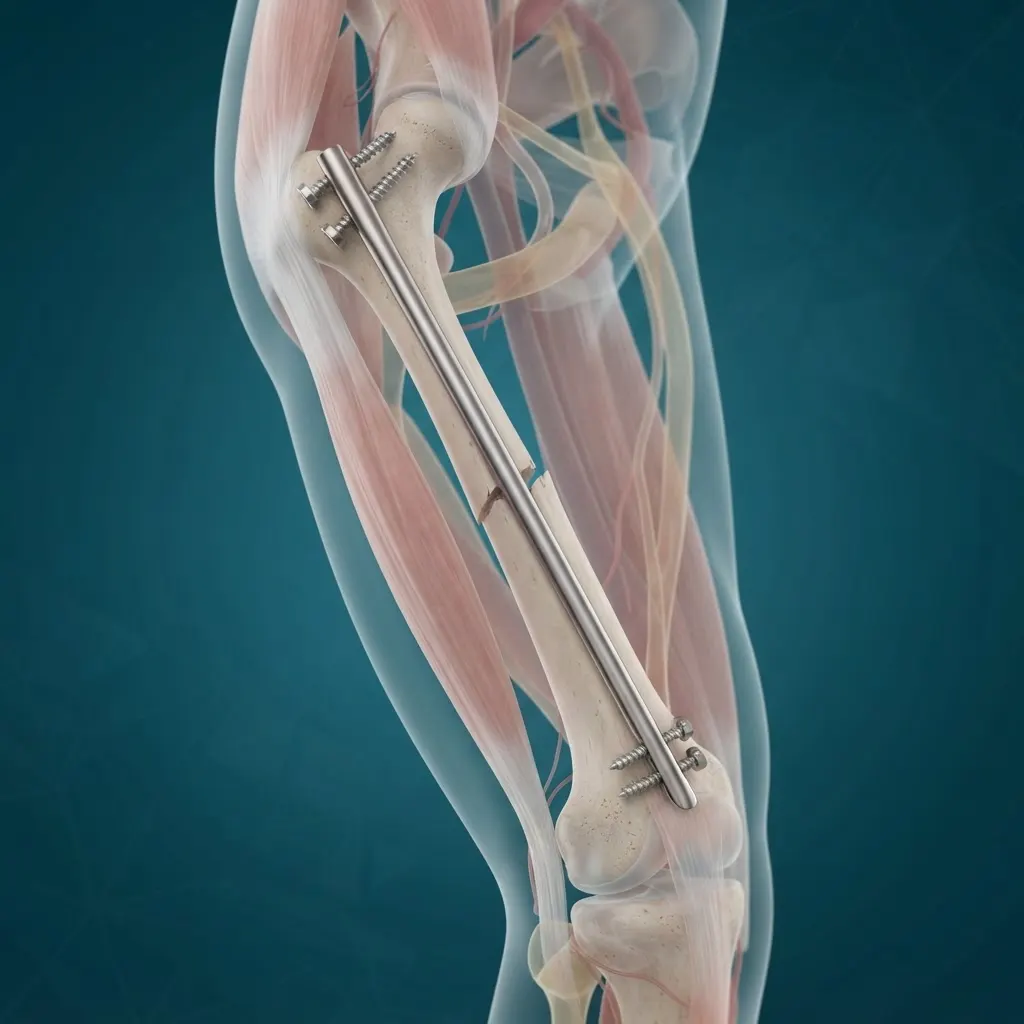
Intramedullary Nailing
Intramedullary nailing in India for selected long-bone fractures using locked internal fixation after fracture imaging, soft-tissue and neurovascular assessment.
Related Conditions
Our services are FREE and by using our services your hospital bill does not increase!
About Intramedullary Nailing
Intramedullary nailing in India is an orthopaedic trauma procedure used to stabilise selected long-bone fractures by placing a metal nail inside the medullary canal. It is commonly used for fractures of the femur and tibia and for selected humeral fractures, with nail design, entry point and locking configuration chosen according to the bone, fracture location and patient anatomy.
Planning includes X-rays that show the full injured bone and adjacent joints, with CT added for selected complex, metaphyseal or joint-extending fractures. The trauma surgeon assesses displacement, comminution, whether the fracture is open or closed, soft-tissue condition, neurovascular status and associated injuries. Open fractures may require urgent antibiotics, debridement and temporary stabilisation before definitive nailing.
The nail is usually secured with proximal and distal locking screws to control length and rotation while healing occurs. Important complications include infection, malalignment or malrotation, delayed union or non-union, hardware irritation, joint stiffness and nerve or vessel problems related to the injury or procedure. Weight-bearing and rehabilitation depend on the bone, fracture pattern and fixation stability. Severe increasing pain with tense swelling, new loss of sensation or circulation, or signs of infection require urgent local assessment rather than planned medical travel.
Cost in India depends on the bone and fracture complexity, nail and locking-screw system, open versus closed injury, imaging, anaesthesia, hospital stay, additional debridement or soft-tissue procedures and rehabilitation. Staged treatment, bone grafting or treatment of infection can materially change the estimate.
India has tertiary orthopaedic and trauma centres with fracture surgeons, modern intramedullary fixation systems, imaging, soft-tissue reconstruction support and rehabilitation services. Medical Help India is a connection platform that can connect medically stable international patients with an appropriate healthcare partner to review fracture imaging and previous treatment, assess fixation options and provide an individual treatment and cost estimate.
What's Included
Why consider treatment in India?
Access to experienced specialists
Advanced treatment and diagnostic options
More affordable hospital care
Shorter waiting times for treatment
Help comparing hospitals, plans and costs
Support with appointments, travel and follow-up
Cost in India
USDFinal costs depend on the medical assessment, hospital, room category and clinical needs.
How it works
Share your details
Tell us about your health concerns, age and current location.
Receive a call
We call you to discuss your situation, needs and questions.
Receive a treatment plan
Get information about the most suitable treatment plan, hospital and estimated cost.
Choose your plan
Review the options and agree on your care and travel plan.
Get full support
Receive full support throughout every stage of your care journey.
Receive care in India
Receive your planned care with support throughout your stay.
Top Hospitals for Intramedullary Nailing
View All Hospitals →
Top Doctors for Intramedullary Nailing
View All Doctors →
Frequently Asked Questions
How much does Intramedullary Nailing cost in India?
The cost of Intramedullary Nailing in India depends on the hospital, specialist team, investigations, treatment complexity and any additional care required. A final estimate is usually prepared after a healthcare provider reviews your medical records.
Which medical reports are useful to have ready for Intramedullary Nailing?
Have ready: the most recent records you have, such as your diagnosis, doctor’s notes, blood tests, imaging, pathology reports, procedure reports and current medication list. The exact documents needed depend on the treatment and your medical history.
Which fractures are commonly treated with intramedullary nails?
Selected long-bone fractures of the femur, tibia and humerus are common indications, depending on fracture level, pattern and soft-tissue condition.
Why is a nail placed inside the bone?
Positioning the implant in the medullary canal provides load-sharing fixation close to the mechanical axis of the limb.
What complications can occur after intramedullary nailing?
Possible complications include infection, malalignment, delayed union or non-union, hardware irritation and stiffness related to the injury or surgery.

Our services are FREE
We connect you with leading hospitals and specialists in India. You pay the hospital directly.