
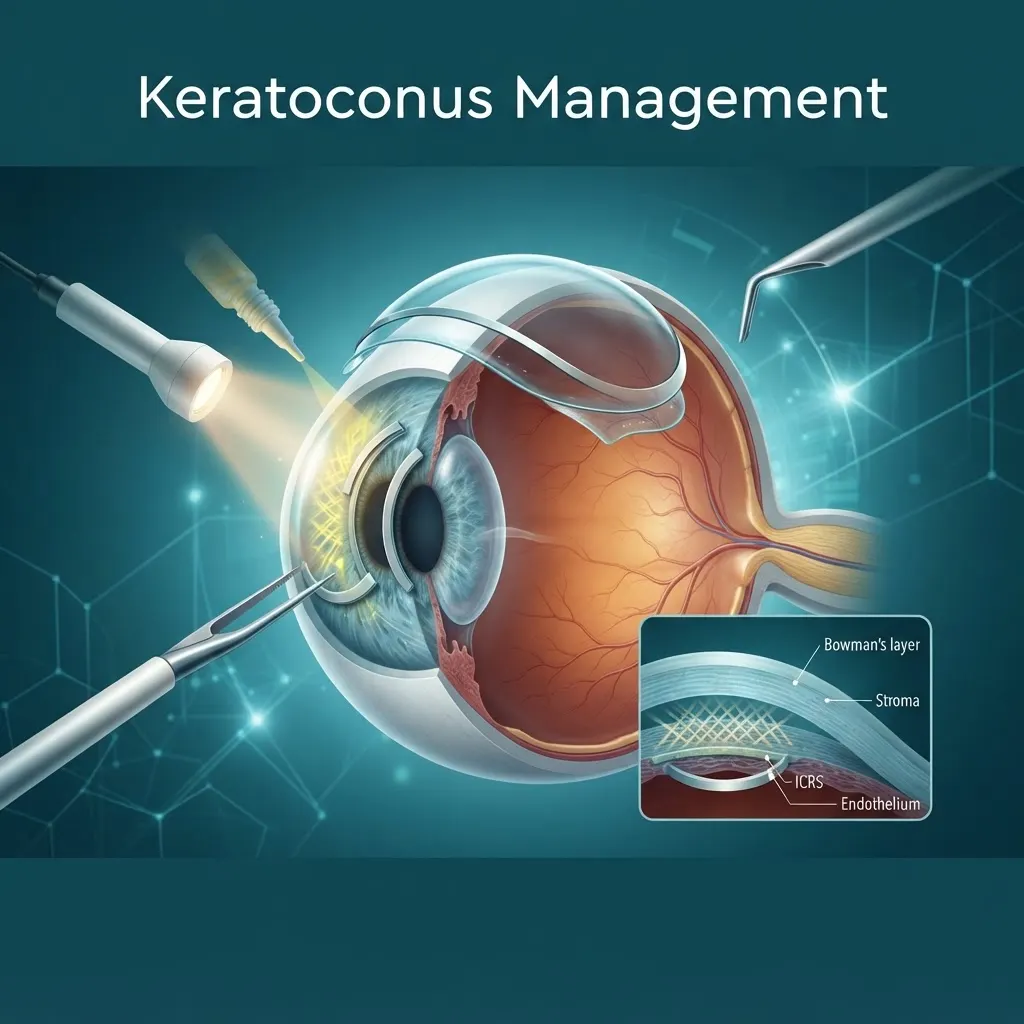
Keratoconus Management
Keratoconus management in India with corneal tomography, specialty lenses and cross-linking for suitable progressive disease, with transplantation reserved for selected advanced cases.
Related Conditions
Our services are FREE and by using our services your hospital bill does not increase!
About Keratoconus Management
Keratoconus management in India aims to improve vision and, when progression is documented, reduce further weakening and deformation of the cornea. Treatment depends on age, corneal shape and thickness, visual quality, scarring and whether serial imaging shows progression, rather than using the same procedure for every patient.
Assessment by a cornea specialist includes corneal topography or tomography, pachymetry, refraction and slit-lamp examination. Previous scans are valuable because progression is determined by change over time. Glasses may provide adequate vision in early disease, while rigid gas-permeable, hybrid or scleral contact lenses can improve optical quality when irregular astigmatism becomes more pronounced.
Corneal cross-linking (CXL) is primarily intended to slow or halt progression in suitable corneas; it does not guarantee that glasses or contact lenses will no longer be needed. Selected patients may be considered for intracorneal ring segments or other specialist approaches, while advanced scarring, severe thinning or contact-lens intolerance can require corneal transplantation. Sudden painful visual deterioration should be assessed promptly because acute corneal hydrops or another eye problem may require urgent ophthalmic care.
Cost in India depends on corneal tomography and other imaging, specialty contact lenses, cross-linking protocol, additional corneal procedures and the number of follow-up visits. Keratoplasty has a separate cost and recovery pathway from CXL or contact-lens management.
India has specialist eye hospitals and tertiary centres with cornea surgeons, tomography, cross-linking platforms, specialty contact-lens services and corneal transplantation. Medical Help India is a connection platform that can connect medically stable international patients with an appropriate ophthalmology healthcare partner to review current and previous corneal scans, assess progression and provide an individual treatment and cost estimate.
What's Included
Why consider treatment in India?
Access to experienced specialists
Advanced treatment and diagnostic options
More affordable hospital care
Shorter waiting times for treatment
Help comparing hospitals, plans and costs
Support with appointments, travel and follow-up
Cost in India
USDFinal costs depend on the medical assessment, hospital, room category and clinical needs.
How it works
Share your details
Tell us about your health concerns, age and current location.
Receive a call
We call you to discuss your situation, needs and questions.
Receive a treatment plan
Get information about the most suitable treatment plan, hospital and estimated cost.
Choose your plan
Review the options and agree on your care and travel plan.
Get full support
Receive full support throughout every stage of your care journey.
Receive care in India
Receive your planned care with support throughout your stay.
Top Hospitals for Keratoconus Management
View All Hospitals →


Top Doctors for Keratoconus Management
View All Doctors →
Frequently Asked Questions
How much does Keratoconus Management cost in India?
The cost of Keratoconus Management in India depends on the hospital, specialist team, investigations, treatment complexity and any additional care required. A final estimate is usually prepared after a healthcare provider reviews your medical records.
Which medical reports are useful to have ready for Keratoconus Management?
Have ready: the most recent records you have, such as your diagnosis, doctor’s notes, blood tests, imaging, pathology reports, procedure reports and current medication list. The exact documents needed depend on the treatment and your medical history.
How is keratoconus progression monitored?
Corneal topography or tomography and pachymetry are used over time to assess changes in corneal shape and thickness.
What does corneal cross-linking do?
Cross-linking strengthens the corneal tissue to slow or halt progression in suitable patients; it is not primarily designed to eliminate glasses or contact lenses.
When might a corneal transplant be needed?
Transplantation may be considered in advanced keratoconus with severe scarring, very poor vision or intolerance of other optical and surgical options.

Our services are FREE
We connect you with leading hospitals and specialists in India. You pay the hospital directly.