
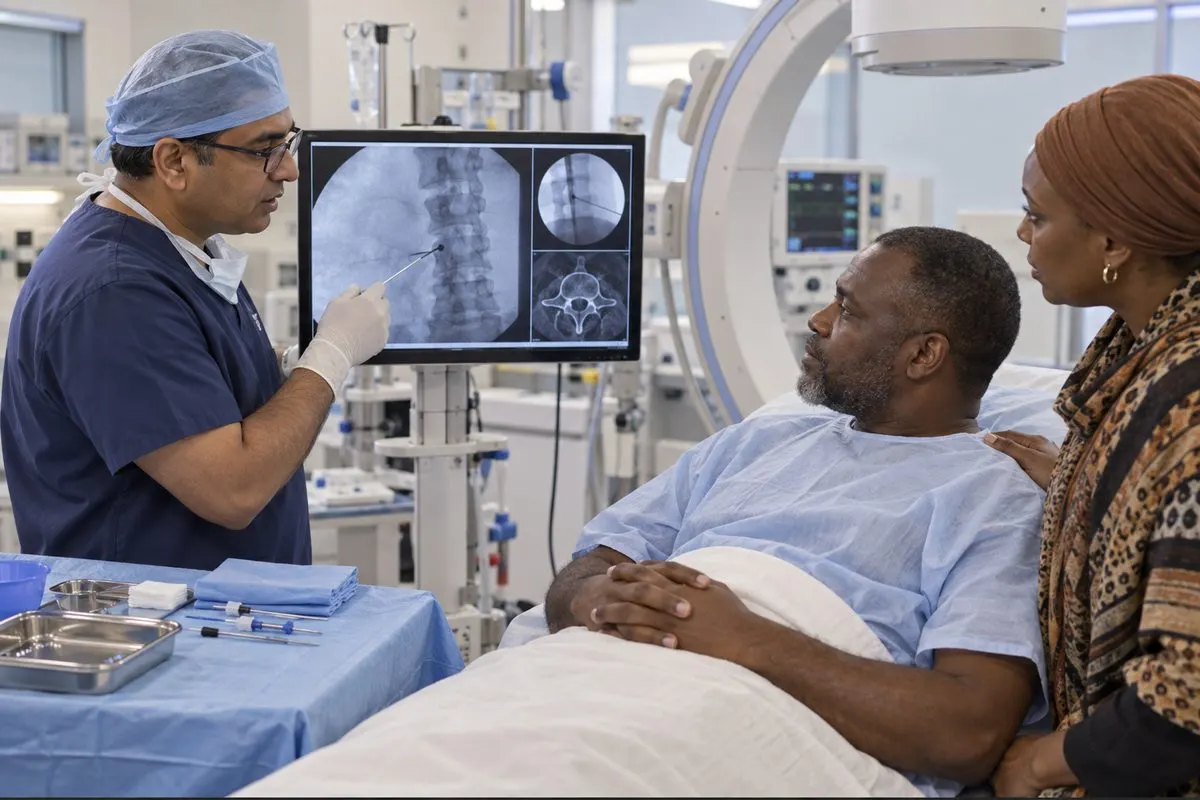
Percutaneous Disc Decompression
Percutaneous disc decompression in India for carefully selected contained disc herniations after MRI correlation and specialist spine or pain assessment.
Related Conditions
Our services are FREE and by using our services your hospital bill does not increase!
About Percutaneous Disc Decompression
Percutaneous disc decompression in India refers to minimally invasive intradiscal procedures used for carefully selected patients with a contained cervical or lumbar disc herniation and matching radicular symptoms. The goal is to reduce pressure within the disc through a needle or small access route, but these procedures are not equivalent to standard microdiscectomy and are not appropriate for every disc prolapse.
Assessment should include a spine or interventional pain examination and MRI correlation with the patient’s symptoms and neurological findings. A contained disc bulge with persistent radicular pain despite appropriate conservative treatment is more likely to be considered than a large extruded or sequestered fragment. Significant spinal stenosis, instability, infection, tumour or progressive neurological deficit generally requires a different treatment strategy.
Techniques vary and may use mechanical, thermal or other methods to remove or modify a small amount of nucleus material. Evidence and indications differ between devices and approaches, so the expected benefit should be discussed realistically. New or progressive weakness, saddle numbness, loss of bladder or bowel control or rapidly worsening neurological symptoms requires urgent local assessment rather than elective travel planning.
Cost in India depends on the spinal level, technique and disposable equipment, imaging guidance, anaesthesia or sedation, hospital or day-care setting and follow-up. Tertiary spine and pain centres in India can compare percutaneous decompression with epidural treatment, microdiscectomy, decompression or other options when appropriate. Medical Help India can connect international patients with an appropriate healthcare partner to review MRI and prior treatment, confirm whether the procedure is suitable and provide an individual estimate.
What's Included
Why consider treatment in India?
Access to experienced specialists
Advanced treatment and diagnostic options
More affordable hospital care
Shorter waiting times for treatment
Help comparing hospitals, plans and costs
Support with appointments, travel and follow-up
Cost in India
USDFinal costs depend on the medical assessment, hospital, room category and clinical needs.
How it works
Share your details
Tell us about your health concerns, age and current location.
Receive a call
We call you to discuss your situation, needs and questions.
Receive a treatment plan
Get information about the most suitable treatment plan, hospital and estimated cost.
Choose your plan
Review the options and agree on your care and travel plan.
Get full support
Receive full support throughout every stage of your care journey.
Receive care in India
Receive your planned care with support throughout your stay.
Top Hospitals for Percutaneous Disc Decompression
View All Hospitals →
Frequently Asked Questions
How much does Percutaneous Disc Decompression cost in India?
Cost depends on the spinal level, percutaneous technique and disposable equipment, imaging guidance, anaesthesia or sedation, day-care versus admission and follow-up. If MRI review shows that microdiscectomy, decompression or another procedure is more appropriate, the treatment estimate will differ.
Which medical reports are useful to have ready for Percutaneous Disc Decompression?
Have ready: recent spine MRI images and report, spine or pain-specialist notes and records of physiotherapy, medicines or injections already tried. Include pain distribution, numbness or weakness, symptom duration and any bladder, bowel or saddle-sensation changes.
Who may be suitable for percutaneous disc decompression?
It is generally limited to carefully selected patients with contained disc herniation and matching radicular symptoms after conservative treatment.
Is percutaneous disc decompression the same as microdiscectomy?
No. Percutaneous techniques reduce intradiscal material through a needle or small access route, while microdiscectomy surgically removes compressive disc material.
Can a large extruded disc be treated this way?
Large extruded or sequestered fragments are generally not good candidates and may require a different treatment strategy.

Our services are FREE
We connect you with leading hospitals and specialists in India. You pay the hospital directly.