
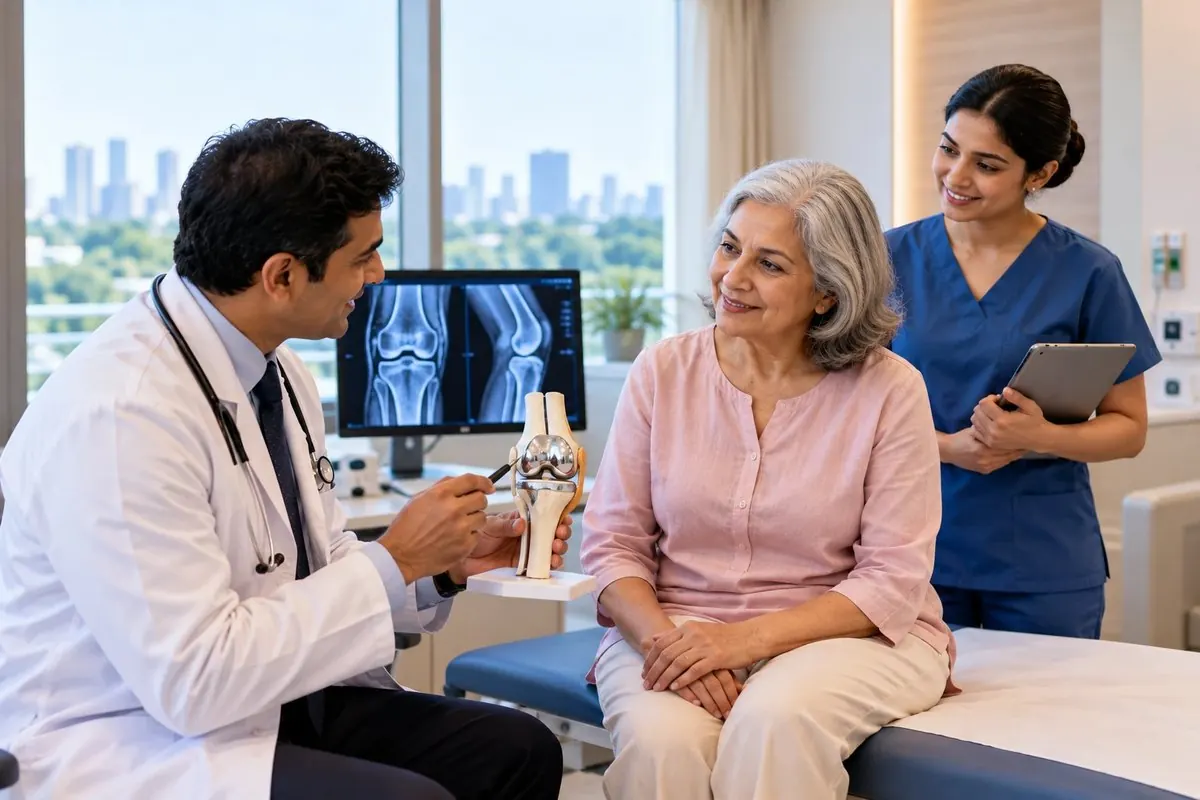
Choosing the best hospital for knee replacement in India depends on more than the hospital name. The surgeon’s experience, the type of knee replacement you need, robotic or navigation technology, revision capability, rehabilitation and the hospital’s ability to manage other medical conditions all matter. This guide compares leading Indian hospitals using a transparent Medical Help India methodology and currently available public evidence.
Best hospitals for knee replacement in India: Medical Help India ranking
| Rank | Hospital | Clinical score | International patient score | Main strengths | Limitations |
|---|---|---|---|---|---|
| 1 | Medanta – The Medicity Gurugram | 94/100 | 9/10 | Exceptional documented knee-replacement surgeon volume; dedicated orthopaedic institute; primary, bilateral and complex joint replacement; strong rehabilitation and multispecialty backup. | Hospital-level complication and revision rates are not publicly reported in a standardized form for direct comparison. |
| 2 | Max Super Speciality Hospital, Saket New Delhi | 91/100 | 9/10 | Dedicated orthopaedics, joints and robotic-surgery leadership; Mako technology in the Saket network; strong primary and complex joint replacement team. | Public hospital-specific long-term knee outcome data remain limited. |
| 3 | Artemis Hospital Gurugram | 89/100 | 9/10 | Dedicated robotic knee-replacement programme; senior robotic joint-replacement and arthroscopy leadership; total and partial replacement with rehabilitation support. | Hospital marketing publishes success-rate claims, but they are not used heavily here because they are not independently risk-adjusted. |
| 4 | Fortis Memorial Research Institute Gurugram | 88/100 | 9/10 | Orthopaedics, Joint Replacement & Sports Medicine centre; advanced surgical infrastructure; partial and total knee replacement within Fortis orthopaedics. | Less hospital-specific public knee-replacement volume evidence than Medanta. |
| 5 | Indraprastha Apollo Hospital New Delhi | 87/100 | 10/10 | Large orthopaedics programme; Apollo network experience with Mako and NAVIO/CORI; excellent tertiary-care and international-patient infrastructure. | Robotic platform availability varies by Apollo centre and must be confirmed for the exact hospital and surgeon. |
Scoring note: These scores are Medical Help India editorial assessments based on currently available public evidence. They are designed to compare clinical capabilities and should not be interpreted as predicted outcomes for an individual patient.
1. Medanta – The Medicity, Gurugram — 94/100
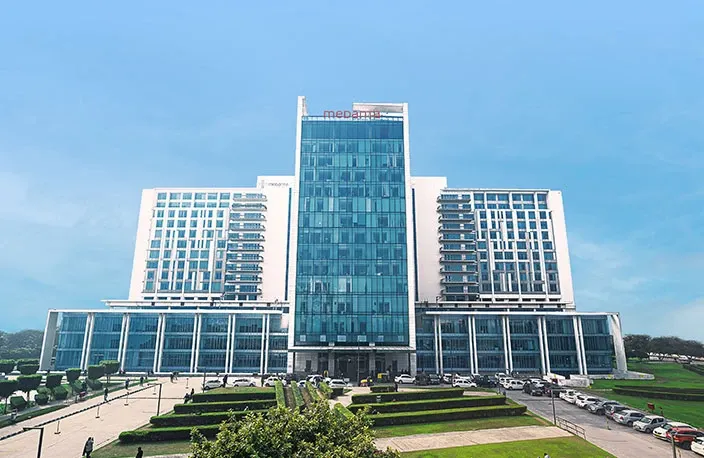
Medanta – The Medicity ranks first because of the depth of its knee-replacement experience and unusually strong public evidence of surgeon volume. In August 2025, Medanta reported that Dr. Ashok Rajgopal had completed 40,000 knee replacement surgeries during his career. He leads the Medanta Institute of Musculoskeletal Disorders and Orthopaedics and is closely associated with knee arthroplasty and advanced joint-replacement techniques.
Pros
- Exceptional documented knee-replacement surgeon volume.
- Dedicated musculoskeletal and orthopaedic institute.
- Strong experience in primary, bilateral and complex joint replacement.
- Integrated physiotherapy, pain management and rehabilitation.
- Excellent multispecialty and critical-care backup.
Cons
- High surgeon volume does not by itself predict an individual outcome.
- Comparable hospital-level infection, revision and patient-reported outcome data are not publicly standardized.
2. Max Super Speciality Hospital, Saket — 91/100
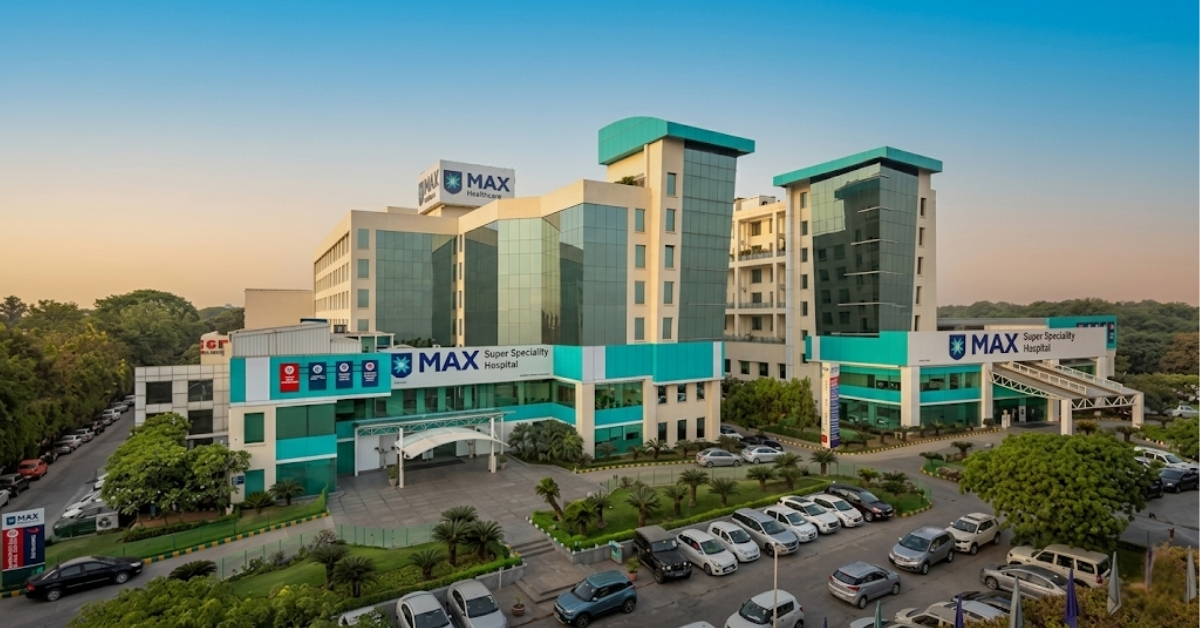
Max Super Speciality Hospital, Saket scores strongly because joint replacement and robotic orthopaedics are established clinical programmes. Current Max profiles include senior leaders specifically focused on orthopaedics, joints and robotic surgery, including Dr. S.K.S. Marya, Dr. Sujoy Bhattacharjee and Dr. Ramneek Mahajan. Max Smart Super Speciality Hospital, Saket also lists the Mako robotic-arm system for joint replacement.
Pros
- Dedicated senior leadership in joint replacement and robotic orthopaedics.
- Mako robotic-arm technology within the Saket network.
- Strong primary and complex joint-replacement capability.
- Broad tertiary-care support.
- Well-developed international-patient services.
Cons
- Robotic technology should not be treated as automatically superior for every patient.
- Public hospital-specific long-term revision and complication statistics are limited.
3. Artemis Hospital, Gurugram — 89/100
Artemis Hospital ranks highly because it has a clearly defined robotic knee replacement programme. Artemis lists Dr. I.P.S. Oberoi as Chairperson of the Orthopaedics Programme and Chief of Robotic Joint Replacement & Arthroscopy Surgery. Its programme covers robotic total and partial knee replacement, while the wider orthopaedic service also includes arthroscopy and joint-preserving options.
Pros
- Dedicated robotic knee-replacement programme.
- Senior specialist leadership in robotic joint replacement and arthroscopy.
- Total and partial knee replacement capability.
- In-house rehabilitation, physiotherapy and pain-management support.
- Established international-patient pathway.
Cons
- Hospital-published success-rate claims are not equivalent to independent risk-adjusted outcome data.
- Public long-term implant-survival and revision-rate data are limited.
4. Fortis Memorial Research Institute, Gurugram — 88/100

Fortis Memorial Research Institute (FMRI) is a major quaternary-care hospital with a dedicated Orthopaedics, Joint Replacement & Sports Medicine centre. Fortis orthopaedics publishes partial/unicondylar knee replacement and Mako robotic partial knee replacement among its joint-replacement procedures, while FMRI provides the imaging, ICU and multispecialty infrastructure needed for complex surgical patients.
Pros
- Dedicated Orthopaedics, Joint Replacement & Sports Medicine service.
- Access to advanced and robotic surgical infrastructure within Fortis orthopaedics.
- Strong tertiary and critical-care support.
- Relevant when sports-medicine or joint-preserving evaluation is also needed.
- Dedicated international-patient programme.
Cons
- Hospital-specific knee-replacement volumes are not published as clearly as Medanta’s surgeon-volume evidence.
- Patients should confirm the exact robotic platform and procedure availability at FMRI.
5. Indraprastha Apollo Hospital, New Delhi — 87/100
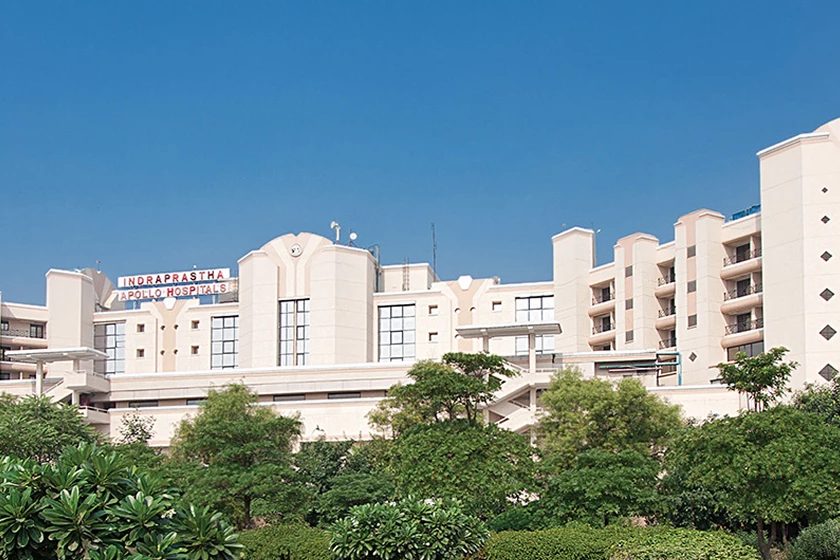
Indraprastha Apollo Hospital combines a large orthopaedic department with the international-patient infrastructure of the Apollo network. Apollo publicly documents robotic-assisted joint replacement using systems including Mako and NAVIO/CORI. NAVIO and CORI are designed specifically for knee arthroplasty, while Mako uses three-dimensional planning and robotic-arm guidance.
Pros
- Large orthopaedic and joint-replacement programme.
- Apollo network experience with Mako and NAVIO/CORI platforms.
- Strong diagnostics, critical care and multispecialty support.
- Very mature international-patient coordination.
Cons
- Robotic-system availability varies by Apollo location.
- Patients should confirm the exact surgeon, hospital and technology rather than relying on group-level information.
Which hospital is strongest for a particular need?
| Patient need | Hospitals worth comparing first |
|---|---|
| Very high-volume knee-replacement expertise | Medanta – The Medicity |
| Robotic total knee replacement | Max Saket; Artemis; Apollo; Fortis FMRI |
| Partial / unicompartmental knee replacement | Artemis; Fortis FMRI; Apollo |
| Revision or complex knee replacement | Medanta; Fortis FMRI; Max Saket |
| Knee replacement plus major medical comorbidities | Medanta; Max Saket; Fortis FMRI; Apollo Delhi |
| Need to compare replacement with arthroscopy or joint-preserving surgery | Artemis; Fortis FMRI |
| Strongest international-patient coordination | Apollo Delhi; Medanta; Max Saket; Fortis FMRI; Artemis |
How to use this ranking
A score is a starting point, not a treatment decision. Send the same recent medical records and weight-bearing knee X-rays to two or three appropriate hospitals. Compare the proposed surgeon, exact procedure, implant, robotic or conventional approach, expected hospital stay, rehabilitation plan and written estimate.
- Ask for the name of the surgeon who will personally perform or supervise the operation.
- Ask how many total, partial or revision knee replacements that surgeon performs.
- Ask why total replacement is recommended instead of partial replacement or continued non-surgical treatment.
- Ask which implant is proposed and why.
- Ask whether robotic or navigation technology is recommended for a clinical reason or simply offered as an upgrade.
- Ask about infection prevention, blood-clot prevention, pain control and early mobilisation.
- Ask when you will be fit to fly and what rehabilitation must continue at home.
For a broader framework, see our guide to choosing a hospital in India and browse knee treatments and estimated costs.
How we assessed the hospitals
The Clinical Score is based on seven areas: surgeons and specialist knee-replacement expertise (25%), procedure depth including total, partial, bilateral and revision surgery (20%), robotic/navigation technology and surgical infrastructure (15%), published case volume and outcomes where meaningful public evidence exists (15%), complex-case and multispecialty capability (10%), rehabilitation and peri-operative support (10%), and clinical transparency and publicly verifiable programme information (5%). International-patient services are scored separately. This is an editorial comparison, not an official government ranking and not a prediction of surgical success.
Frequently asked questions
What is the number one hospital for knee replacement in India?
In the Medical Help India methodology, Medanta – The Medicity ranks first because of its dedicated orthopaedic programme, complex joint-replacement capability and unusually strong documented surgeon-volume evidence, including Medanta’s 2025 report that Dr. Ashok Rajgopal had completed 40,000 knee replacements. This does not mean Medanta is automatically the best choice for every patient.
Which hospital is best for robotic knee replacement in India?
Max Saket, Artemis, Apollo and Fortis are all worth comparing for robotic-assisted knee replacement. The exact surgeon and robotic platform matter more than the hospital brand alone, and availability should be confirmed at the specific facility before travel.
Is robotic knee replacement better than conventional knee replacement?
Robotic systems can improve planning and assist with precise bone preparation and implant positioning, but they do not guarantee a better result. Outcomes also depend on patient selection, surgeon expertise, implant choice, rehabilitation and overall health.
Which hospital should I compare for revision knee replacement?
Medanta, Fortis FMRI and Max Saket are reasonable centres to compare for complex or revision cases. Revision surgery requires different expertise from a straightforward first knee replacement, especially when infection, bone loss, instability or previous implants are involved.
Sources and medical references
Next step for international patients
Collect your recent weight-bearing knee X-rays, MRI if available, previous surgery records, current medications and a short medical history. Then compare hospitals in India, review orthopaedic and joint-replacement surgeons and explore knee treatment options and costs. With your consent, Medical Help India will connect you with relevant healthcare providers who can help coordinate suitable hospital and doctor options, appointments, travel support, admission and follow-up. Our service is free for patients and does not increase the hospital bill. Medical decisions remain with the treating doctor.